

Give Feedback Effectively: From Fear to Confidence
There’s a particular feeling that comes just before giving or receiving feedback. You know the one - the tightening in your stomach, the slight rush of heat in your chest, that quiet panic whispering “here we go…”
Even the word feedback can make people tense up. It’s so often tangled with fear of hurting someone’s feelings, of being misunderstood, or of hearing something that bruises our own confidence.
But the thing is: the ability to give feedback effectively is one of the most powerful leadership skills you can build.
When done well, it strengthens trust, deepens relationships, and fuels growth.
When done badly - or not at all - it quietly erodes performance, confidence, and connection.
And yet, so many of us get stuck in the same trap: we care deeply, but we don’t know how to say the hard thing without making it awkward.
The Tightrope of Leadership

Giving feedback can feel like walking a tightrope; one step too far either way and you’re falling into trouble.
Early in my leadership journey, I was convinced I’d mastered it.
I proudly told my line manager that I’d perfected the art of the feedback sandwich. You know, something positive, something tricky, something positive again.
She smiled and said, “So… the shit sandwich, then?”
That was a humbling moment.
Because she was right.
I was serving up what I now call a wafer-thin slice of honesty in a massive bun of fluff.
I thought I was being kind. But in truth, I was avoiding discomfort; protecting myself more than supporting the other person.
And the thing is, people always sense when something uncomfortable is coming.
You can feel it before you hear it.
All that verbal padding doesn’t soften the message - it just builds tension and distrust.
That was the day I learned an important truth: kindness without clarity isn’t kind.
The Feedback Reframe
Everything changed when I discovered Radical Candor - Kim Scott’s simple but transformative feedback model.
It’s built around two principles:
Care personally.
Challenge directly.
When you care personally, you show empathy and respect. When you challenge directly, you provide clarity and accountability. When both are present, feedback becomes a gift.
Scott writes:
“Make sure that you are seeing each person on your team with fresh eyes every day. … Care personally; don’t put people in boxes and leave them there.”
Without challenge, you fall into what Scott calls Ruinous Empathy - you care so much about protecting feelings that you avoid the truth.
Without care, you risk Obnoxious Aggression - honesty without humanity.
And when you do neither, you end up with Manipulative Insincerity - pretending everything’s fine to keep the peace.
The balance point between those extremes is Radical Candor: feedback that’s human, honest, and growth-focused.
It’s feedback that says, “I care about you enough to tell you the truth.”
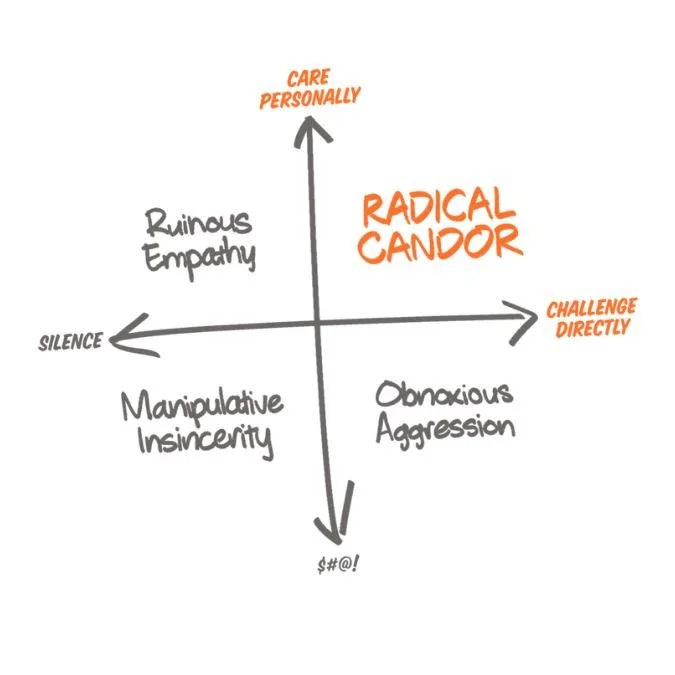
From Kim Scott’s Radical Candor
When Kindness Without Clarity Hurts
A manager once told me about a brilliant young employee she adored working with.
He was eager, kind, and full of enthusiasm, but he was struggling to meet expectations. She didn’t want to hurt his feelings, so she avoided giving him tough feedback.
Instead, she quietly stayed late fixing his work and convinced herself she was being supportive.
Eventually, her boss noticed, and the situation came to a head.
The young man was let go - not because he didn’t care, but because no one had told him what to improve.
That manager’s intentions were good, but her kindness without clarity cost him his job.
It’s a painful lesson many leaders learn too late.
When we avoid giving feedback to protect someone’s feelings, we deny them the opportunity to grow.
Real care isn’t about keeping people comfortable - it’s about helping them thrive.
How to Give Feedback Effectively: The 4Cs Framework
If you’re wondering how to actually give feedback that lands, try my 4C Framework. It keeps me grounded, calm, and clear.
Context – When and where did it happen?
Content – What exactly did you observe?
Consequence – Why does it matter?
Collaboration – What can we do together to move forward?
It’s simple but powerful. Here’s what it sounds like:
“In yesterday’s meeting (context), I noticed the client presentation wasn’t quite ready (content). It made things a bit stressful for the team (consequence). Can we look at how to plan ahead next time (collaboration)?”
You’re not criticising the person. You’re describing a behaviour, its impact, and inviting collaboration.
That’s leadership in action.
And the way you open that conversation sets the tone. Avoid the build-up or the “we need to talk” dread. Try this instead:
“I’d like to share something that could help us work even better together. Please know this comes from a place of care - I really value what you do, and I want to make sure we’re both clear on how to move things forward.”
That one sentence signals respect, safety, and intent.
Receiving Feedback Without Falling Apart
Of course, giving feedback is only half the picture. Receiving it can be just as tough - especially when you’ve poured your heart into something.
When I’ve worked extremely hard on a project and someone points out what could have been better, I feel it deeply. My inner voice kicks in: “They don’t appreciate how much I’ve worked.” That’s my own version of victimhood creeping in.
In Thanks for the Feedback, Stone and Heen explain that our resistance usually comes from one of three triggers:
“Truth Triggers”, “Relationship Triggers” and “Identity Triggers.”
For me, it’s the identity one that stings the most. When feedback challenges how we see ourselves, we instinctively go into defence mode.
But feedback isn’t done to us - it’s offered to us.
We get to choose whether to accept it, question it, or learn from it.
When I catch myself reacting, I use what I now call the Pause–Process–Pivot approach:
Pause: Notice the emotional response.
Process: Ask, “What’s useful here?”
Pivot: Decide how to grow from it.
It’s a tiny shift that moves me from defensiveness to curiosity.
Why Psychological Safety Matters More Than Skill
No feedback strategy works without trust. Psychological safety - the belief that it’s safe to speak, ask questions, and make mistakes - is the foundation of every high-performing team.
Without safety, feedback feels like attack.
With safety, feedback feels like care.
Scott nails it when she says:
“The way you ask for criticism and react when you get it goes a long way toward building trust – or destroying it.”
And remember: your tone sets the tone.
Building that kind of environment starts long before the feedback moment.
It’s built in daily trust - following through on promises, checking in with people as humans, not just employees, and modelling vulnerability yourself.
When leaders handle feedback with calm curiosity - saying things like, “Thanks for the input, I’ll reflect on that” - they show that it’s safe to speak honestly.
That’s how a feedback culture begins: one safe, caring, courageous conversation at a time.
Building a Feedback Culture
Over time, I’ve realised that feedback confidence isn’t just about having the right words - it’s about building the right environment.
When feedback becomes part of everyday conversation, people relax. When we give feedback effectively, everything changes.
They stop bracing for criticism and start engaging in honest, productive conversations.
It’s what turns a collection of people into a cohesive team - one that’s honest, resilient, and emotionally intelligent.
Because ultimately, feedback isn’t a performance-management tool. It’s a trust-building exercise.
The Real Lesson
Learning to give feedback effectively doesn’t happen overnight. It takes practice, courage, and a lot of compassion - for others and for yourself.
But when you get it right - when you find that sweet spot between clarity and care - everything changes.
You stop walking the tightrope and start walking with confidence.
Feedback stops being something you dread and starts being something you value.
