

What’s Wrong With My Team?
How to Understand What Your Team Really Needs From You Right Now
At some point, almost every leader quietly asks themselves the same uneasy question:
“What’s wrong with my team?”
Perhaps performance has dipped. Communication feels strained. Energy is lower than it used to be. People who were once proactive now seem hesitant, frustrated, or withdrawn, and you cannot quite pinpoint why.
Before assuming capability or attitude is the problem, it is worth pausing.
In most cases, nothing is fundamentally wrong with the team. What is far more likely is that something essential is missing. When core needs are not being met, even highly capable people struggle to perform at their best.
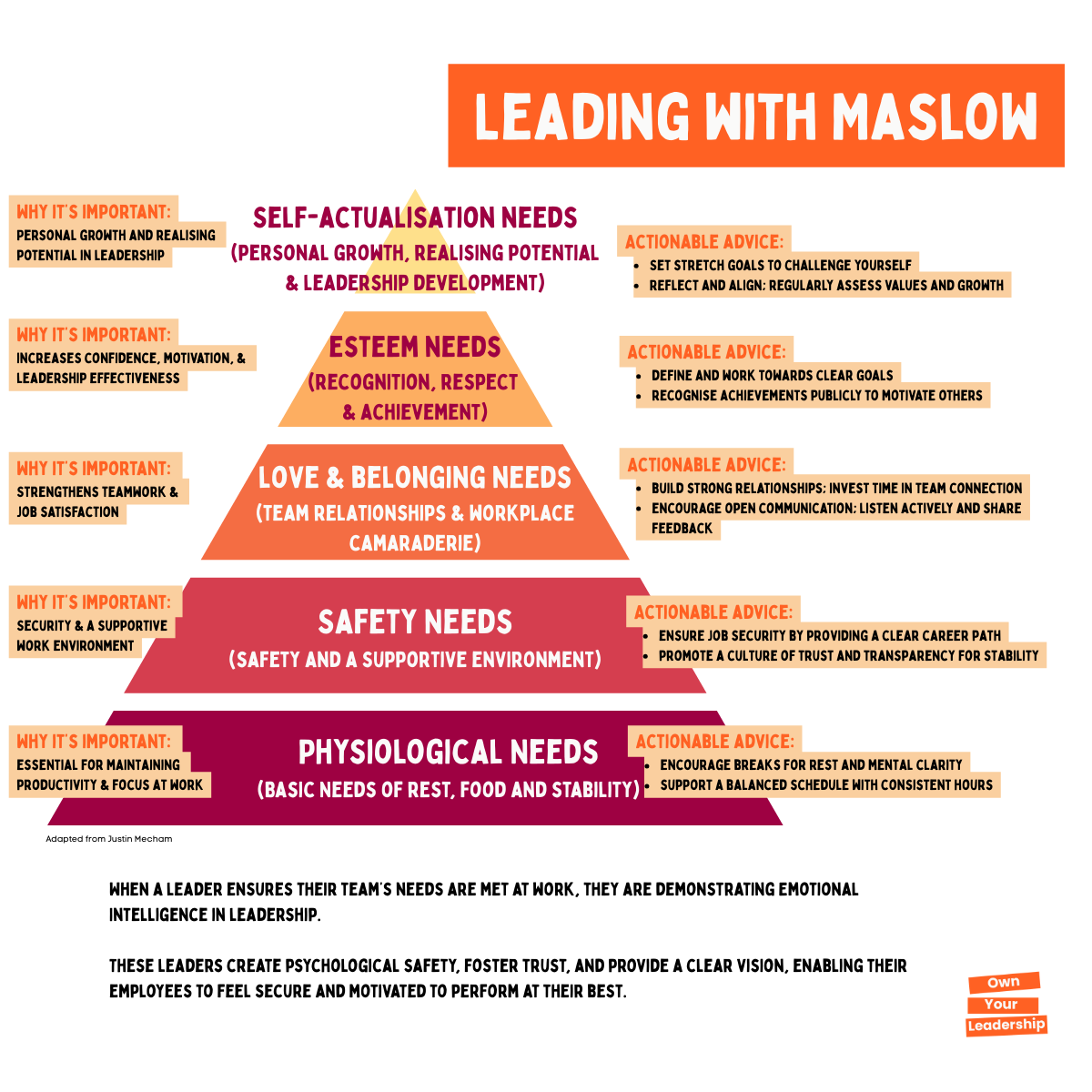
Maslow’s hierarchy offers a useful lens: before asking what is wrong with people, consider whether the conditions for performance are in place.
Instead of focusing on perceived flaws in individuals, it invites you to consider whether the conditions for confidence, collaboration, and motivation are truly in place.
Let’s take a look at how we can use Maslow’s Hierarchy of Needs to support our teams.
When People Are Exhausted, Nothing Else Works
(This corresponds to Maslow’s safety needs)
Sometimes the answer to “What’s wrong with my team?” is surprisingly simple. They are tired.
Excessive workload, constant urgency, lack of breaks, or unpredictable hours erode focus and patience long before motivation disappears.
When basic physical and mental capacity is depleted, even highly committed people struggle to think clearly, collaborate well, or regulate emotions.
Consider whether your team has realistic workloads, protected time to focus, and permission to pause.
Sustainable performance starts with sustainable energy.
When Your Team Feels Unsettled, Consider How Secure They Feel
(This corresponds to Maslow’s physiological needs)
If you find yourself asking what’s wrong with my team because people seem anxious, reactive, or inconsistent, begin with the basics.
Teams cannot operate well without a sense of safety and stability.
Security at work goes beyond job security. It includes psychological safety, clarity of expectations, fairness, and predictability. When these are missing, people spend energy protecting themselves rather than contributing fully.
Consider whether your team knows what success looks like in their roles, or whether they are constantly interpreting shifting priorities. Reflect on how mistakes are handled. A curious, supportive response builds confidence, whereas a tense or critical reaction can quickly shut people down. Workload also plays a part. When people feel permanently overwhelmed, even small tasks can feel heavy.
What may look like poor performance is often a stress response to uncertainty.
When Connection Is Weak, Engagement Drops
(This corresponds to Maslow’s love and belonging needs)
Sometimes the worry behind what’s wrong with my team is a sense that people have drifted apart. Collaboration feels mechanical. Meetings are quiet. Individuals focus on their own responsibilities but little else.
Belonging is a fundamental human need. Without it, motivation erodes quietly rather than dramatically.
Notice who speaks most in discussions and who rarely contributes. Think about whether differing views can be expressed safely or whether tension is avoided. Consider whether remote or less confident team members feel as included as those who are naturally outspoken.
Connection is not built through occasional initiatives. It develops through everyday leadership behaviours that signal respect, fairness, and genuine interest in people as individuals.
When People Feel Invisible, Effort Shrinks
(This corresponds to Maslow’s esteem needs)
A common moment when leaders ask what’s wrong with my team is when discretionary effort disappears. Work still gets done, but without energy, creativity, or pride.
This is often less about motivation and more about recognition.
People need to know that their contributions matter. Specific acknowledgement carries far more weight than general praise. Consistent performers who quietly keep things running deserve attention just as much as standout achievers. Balanced feedback, delivered in a timely way, helps people understand both their strengths and their development areas.
When appreciation is scarce, enthusiasm usually follows.
When Growth Is Missing, Teams Become Flat
(This corresponds to Maslow’s self-actualisation needs)
A team can appear productive while feeling stagnant. Tasks are completed and targets are met, yet there is little sense of momentum or excitement about the future.
This often indicates that development needs are not being addressed.
Reflect on whether you have recently discussed each person’s aspirations or whether assumptions have filled the gap. Consider who receives stretch opportunities and whether they are distributed fairly. Notice how mistakes are treated. When errors become learning conversations, confidence grows. When they become warnings, people play safe.
Most people want to progress, not simply maintain.
When Purpose and Growth Are Unclear, People Only Do What Is Asked
If your team delivers exactly what is required but rarely more, you may again find yourself wondering what’s wrong with my team. In many cases, the issue is not effort but meaning.
People are more engaged when they understand how their work contributes to something beyond immediate tasks. They are also more likely to invest energy when they feel trusted to shape how that work is done.
Think about whether your team can see the bigger picture. Are ideas welcomed, or quietly dismissed because of time pressures? Do people have autonomy, or does everything require approval?
Compliance keeps organisations functioning. Purpose helps them thrive.
A More Helpful Question to Ask Yourself
When the thought what’s wrong with my team arises, a different question often leads to more useful insight:
“What might my team need from me that they are not currently getting?”
Teams tend to respond to the environment created around them.
When leadership behaviour shifts - towards greater clarity, inclusion, recognition, development, or trust - team behaviour usually shifts too.
This is not about blame. It is about influence.
A Quiet Reflection for Thoughtful Leaders
If your team could answer anonymously, what might they say is hardest about working here right now?
And perhaps the most important question of all:
“What small change in my leadership this week would make their experience noticeably better?”
Nothing may be “wrong” with your team at all. They may simply be signalling, in the only ways available to them, what they need in order to perform well again.
Often, what looks like a team problem is actually a signal about leadership presence - how you show up, communicate, and create confidence day to day, not how loud or visible you are, as I explored in this blog on leadership presence not being about being the loudest voice.
If you’d like support to discover how to navigate this further, then book a free discovery call with me to see how I can support you.
