

Edward De Bono’s Thinking Hats: A 360° Decision-Making Tool for Leaders
Making decisions as a leader can sometimes feel like juggling a dozen balls at once, all competing for attention, leaving you spinning, unsure, and often second-guessing yourself.
Sometimes we just need a structure that helps us become unstuck, and this is where Edward De Bono’s Thinking Hats comes in. His 6 thinking hats are a simple yet powerful framework that allows leaders to approach decisions in a structured, holistic, and objective way. Whether you’re making choices on your own or guiding a team, the hats help ensure nothing is overlooked, and everyone can contribute without ego or overwhelm getting in the way.
Recently, I used the thinking hats with a headteacher I was working with, and my client could not believe I was using them. Not because they were inappropriate to use, but because they used the thinking hats in school with their pupils, and they hadn’t ever thought to use them for decision-making with their senior leadership team. In my teaching days, I used the thinking hats for many things: dispute resolution, enterprise activities, book reviews, critical reviews of historical decisions…. the list was endless.
So, What Are Edward De Bono’s Thinking Hats?
Edward De Bono, a pioneer in creative thinking, designed the Six Thinking Hats as a tool to separate different modes of thinking. Each “hat” represents a particular way of approaching a problem:
Some focus on facts and data.
Others bring creativity or optimism.
Some emphasise risks or emotions.
By intentionally switching between these modes - or “wearing” each hat - you can explore a problem from multiple angles, reduce bias, and make decisions with clarity and confidence.
The beauty of this approach is that it works both for solo decision-making and team discussions. Leaders can systematically process all aspects of a challenge without rushing or feeling overwhelmed.
The Six Hats Explained
Here’s a quick guide to each hat and how it can be used in practice:
1. White Hat – Facts and Information
Focus on data, evidence, and available information. Ask: What do I know? What do I need to find out?
Example: Reviewing sales figures before deciding on a new client strategy.
2. Red Hat – Emotions and Intuition
Acknowledge feelings and gut instincts. No justification required—just recognise what people are sensing.
Example: Considering your team’s morale when changing work processes.
3. Black Hat – Caution and Risk
Identify potential problems, obstacles, or reasons a decision might fail. This hat keeps you realistic.
Example: Highlighting possible risks of launching a new project mid-quarter.
4. Yellow Hat – Optimism and Benefits
Look for positives, opportunities, and value in the decision. This hat encourages constructive thinking.
Example: Exploring the benefits of adopting a new tool that could save the team hours each week.
5. Green Hat – Creativity and Alternatives
Generate new ideas, approaches, and solutions. This is the hat for innovation and thinking outside the box.
Example: Brainstorming different ways to improve team collaboration.
6. Blue Hat – Process and Control
Oversee the thinking process. Summarise findings, plan next steps, and ensure all hats are considered.
Example: Leading a meeting where each hat is explored in sequence to reach a final decision.
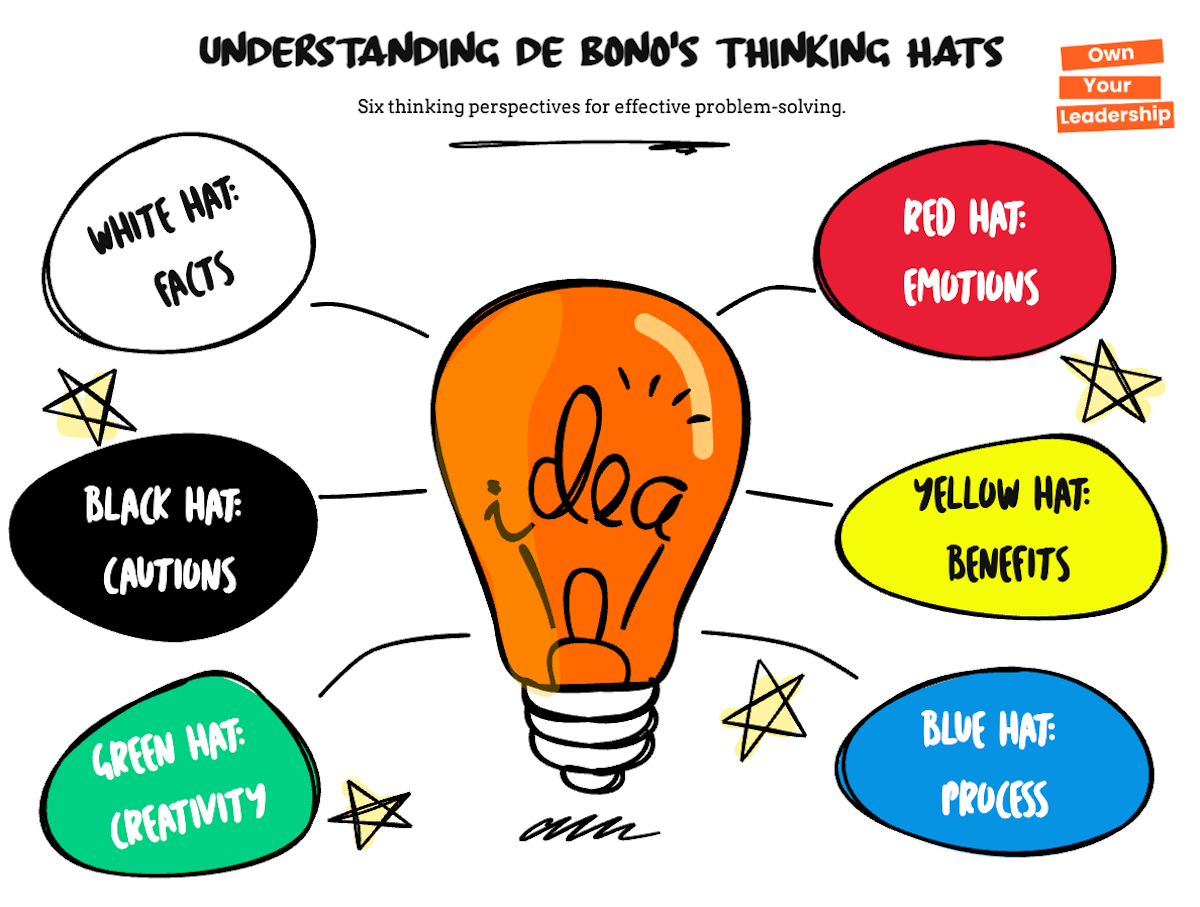
Edward De Bono’s 6 thinking Hats
Why Using the 6 Thinking Hats Works for Leaders
The Six Thinking Hats are powerful because they turn decision-making into a structured, inclusive process. Leaders no longer have to juggle everything in their heads or feel like they must “get it right” alone.
Using the hats:
Encourages balanced, objective decisions
Helps teams contribute meaningfully without conflict
Reduces overwhelm by focusing on one type of thinking at a time
Boosts confidence because every perspective is considered
Whether you’re deciding on a strategic initiative, managing a tricky staffing issue, or planning your next team project, the hats give you a way to think systematically and thoroughly. They truly provide a holistic 360° review of your issue in hand.
How to Use the Hats in Practice
Alone: Work through each hat sequentially. Start with the facts (white), explore feelings (red), weigh risks (black), identify positives (yellow), generate ideas (green), and then review the process (blue). This gives clarity and helps you act with confidence.
With a team: Assign hats to different people or take turns focusing on one hat at a time. This allows everyone to contribute in a structured, non-confrontational way. For example, one team member can focus on potential risks while another explores creative alternatives, ensuring a full 360° view.
The method is flexible, so use it however it suits your situation. The key is intentional thinking.
Key Takeaways
Edward De Bono’s Thinking Hats provide a holistic, objective approach to decision-making.
Leaders can use it alone or with teams to explore facts, emotions, risks, benefits, creativity, and process.
It reduces overwhelm, encourages balanced thinking, and ensures no perspective is missed.
Start with one decision this week and notice the difference in clarity and confidence.
By approaching decisions one hat at a time, you can turn complex challenges into manageable, structured choices, and help your team engage in a clear, objective, and collaborative way.
If you’d like to explore other ways to make decisions as a leader, then please read my blog on Collaborative Clarity. Or if making personal decisions which are aligned to your values are important to you, then this blog on Unlocking the Power of your Values will be right up your street (plus there’s a free download too!).
